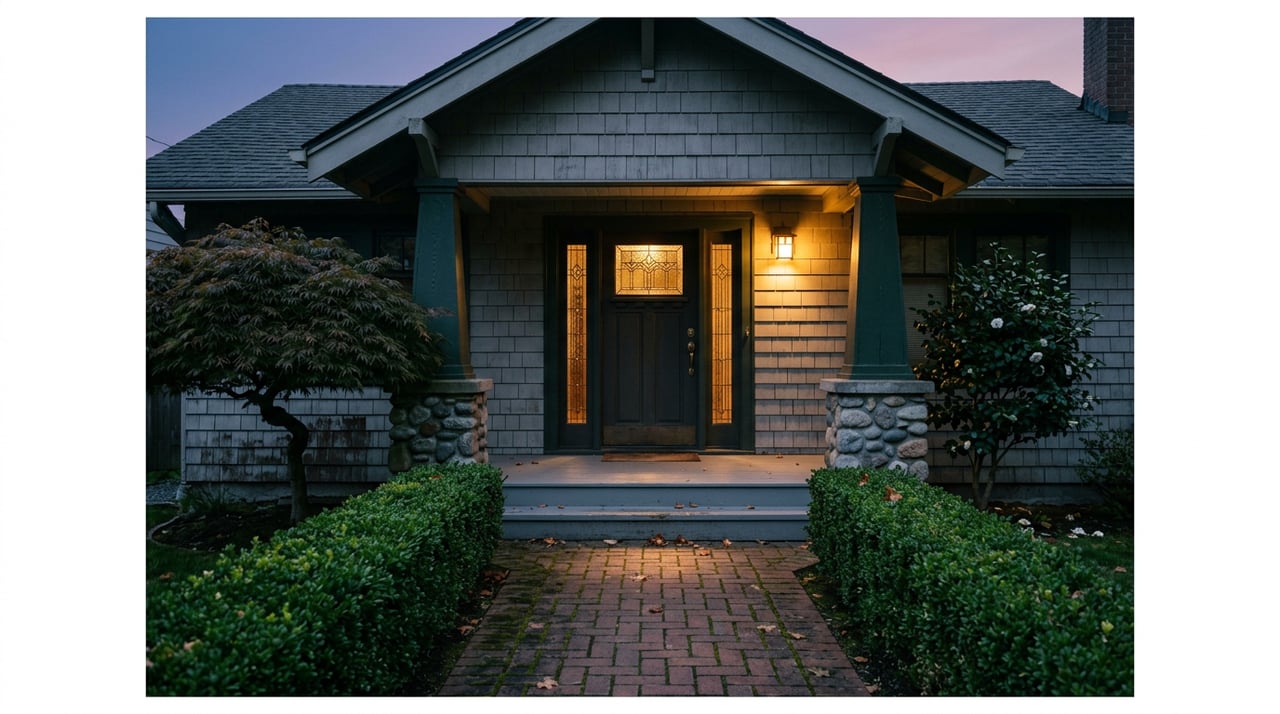
Berkeley Split Into Two Housing Markets Last November. Most Buyers Haven't Noticed Yet.
September 17, 2026
September 17, 2026
"You can build a three-story glass block next to my 1912 Craftsman. I have no input in that."
That's what one Berkeley homeowner told the city council in the summer of 2025, during the meeting that ended single-family zoning across most of the city's flatland neighborhoods. The council voted unanimously anyway. The rule took effect on November 1, 2025, and it did something more specific than most of the coverage let on: it didn't upzone Berkeley. It upzoned the flats, and drew a hard line around the hills.
If you're comparing a bungalow in the flats to a view home in the hills right now, that line matters more than the number on the listing.
The city's Middle Housing ordinance applies to lots zoned R-1, R-2, R-2A, and MU-R, which covers the great majority of Berkeley's residential streets. On a qualifying lot, an owner or developer can now build duplexes, triplexes, fourplexes, or small courtyard apartments without the discretionary hearings that used to make these projects a multi-year bet. Projects that meet the city's objective standards can get approved in 30 days, down from a process that previously ran six to fifteen months.
The ordinance sets real limits. Buildings can rise to 35 feet, roughly three stories, though the roofline has to step down to 22 feet within 15 feet of a rear property line. Lot coverage tops out at 60 percent, and density is capped citywide at 70 units per acre. City planning officials project the changes will add about 1,700 new housing units over the next eight years, a modest number relative to Berkeley's existing housing stock and spread across a long runway.
The exception is the one that matters for anyone shopping right now: the Berkeley Hills. The city carved the hillside fire-hazard overlay out of the ordinance entirely, citing evacuation capacity on the area's narrow, winding streets. Homes there stay under the old single-family rules. Homes in the flats do not.
Here's the split in plain terms:
| Flatland lots (R-1, R-2, R-2A, MU-R) | Hillside overlay | |
|---|---|---|
| Zoning as of Nov. 1, 2025 | Duplex, triplex, fourplex, courtyard apartments allowed by right | Unchanged, single-family only |
| Max height | 35 ft (22 ft near rear lot line) | Existing hillside limits, unchanged |
| Approval timeline for qualifying projects | As fast as 30 days | Standard discretionary review |
| What the lot is worth | Structure plus redevelopment capacity | Structure and site value only |
The disagreement on the council floor wasn't really about whether Berkeley needed more housing. It was about who the new capacity would actually help.
Councilmember Rashi Kesarwani pointed to a UC Berkeley Terner Center for Housing Innovation study suggesting the small-scale projects opened up by this ordinance don't pencil for large developers. The economics favor small-lot, ownership-model middle housing instead, meaning a homeowner adding a unit or two to live in and rent out, not a corporate builder assembling a block of parcels.
Former councilmember Cheryl Davila argued the opposite case just as directly, pointing out that the ordinance dropped the word "affordable" along with the word "missing" somewhere between the early drafts and the final vote. Only 20 percent of new units carry any low-income designation, according to figures cited by residents at the meeting.
And Berkeleyside's coverage of the vote flagged the scenario that should concern anyone house hunting in the flats this year: opponents worried that opening up former single-family lots to redevelopment would put ordinary homebuyers in competition with investors and small developers hunting for teardowns, which could push prices up rather than down. That's the opposite of what an upzoning is supposed to do on paper, and it's exactly the kind of friction that shows up at the offer table, not in the ordinance text.
You can see a version of this split in the first-quarter 2026 numbers. Berkeley condos fell sharply, down 20.8 percent year over year to a median sale price of $625,000. Single-family houses barely moved, with a median sale price of $1.4 million and no meaningful year-over-year change. The two segments of Berkeley's housing stock, sitting inside the same city limits, told almost opposite stories in the same quarter.
That gap lines up with the zoning split. A condo is a fixed unit inside a building someone else controls. A single-family lot in the flats, as of last November, is a fixed unit sitting on top of legal capacity for two, three, or more additional homes. One of these asset types just got a new source of underlying value. The other didn't.
Zoom out to the last six months of closings tracked through August 2026, and the median sold price across the city sits at $1,410,000, with a median of $881 per square foot. The middle half of all sales closed somewhere between $1,010,000 and $2,000,000, a spread wide enough to hold both a flatland Craftsman with by-right duplex potential and a hillside home with none of it. A citywide median can't tell you which one you're looking at. The zoning map can.
If you're bidding on a modest single-family home in the flats this year, understand that you may not just be bidding against another family. Small investors and owner-builders now have a legal path to add units on the same lot types you're shopping, and some of them are pricing offers around what the land can become rather than what the house currently is. That's not a reason to avoid the flats. It's a reason to ask your agent, before you write an offer, whether the parcel falls inside the qualifying zones and what an appraiser is likely to do with that information, since appraisal practice on entitlement value is still catching up to a rule that's less than a year old.
If you're looking in the hills instead, the appeal is now partly about what didn't change. Those neighborhoods keep their existing character under zoning that the rest of the city just moved past. That stability comes bundled with the same evacuation-route considerations the city cited when it wrote the carve-out, which is worth discussing with your agent and your insurer as part of ordinary due diligence, not as a red flag.
One more date worth knowing if you're thinking past this year: the city is still working through a separate, more contested round of upzoning aimed at the Elmwood, North Shattuck, and Solano Avenue commercial corridors, driven by a state housing-element compliance deadline in December 2026. That fight is not settled, and it sits outside the Middle Housing ordinance that already took effect. If your search includes property near any of those three corridors, ask where that process stands before you assume today's zoning is tomorrow's zoning.
Does this apply to every home in Berkeley? No. It applies to lots zoned R-1, R-2, R-2A, and MU-R, which covers most of the flats. The Berkeley Hills fire-hazard overlay is excluded entirely, and the city's GIS portal will show you a specific parcel's zoning designation.
Does this mean my block is about to fill up with apartment buildings? Not on the timeline most buyers picture. City planners project roughly 1,700 new units over the next eight years, and the feasibility studies cited during the council debate suggest small-scale, owner-built projects are more likely than large developer assemblages right now.
Are condos affected the same way as single-family homes? No. The ordinance is about what an existing lot can be redeveloped into, which is why the divergence between condo and single-family pricing in early 2026 tracks the zoning line so closely.
Is the hillside exemption permanent? The city has framed it around fire-hazard status and evacuation capacity rather than a fixed expiration date, so it's worth confirming current status with your agent rather than assuming it's locked in forever.
Reading a Berkeley listing in 2026 means reading two things at once: the house, and the zoning envelope underneath it. If you want help sorting out which side of that line a specific property sits on before you write an offer, Tracy Zhou has been tracking these changes block by block. Let's Connect.
Stay up to date on the latest real estate trends.
remodel
before the first wall comes down
Tracy understands that whether buying or selling a home or an investment property, the decision is an important one. She helps clients invest in their real estate dreams by putting their interests first. Work with Tracy today!